

Environmental
"The most substantial and well documented public health threats are associated with fiberglass."
-Natural Resources Defense Council
"In essence, the dust from cellulose insulation materials can be considered as any household dusts.
Cellulose, per se, is non-toxic. Biologically, cellulose is innocuous."
-Dr. Arthur Furst (one of the world's foremost toxicologists)
"...no adverse health effects from cellulose insulation have been identified."
-Natural Resources Defense Council
A Comparison of Health Concerns
| Fiberglass | Cellulose | |
| Microscopic, respirable glass fibers? | YES | NO |
| Formaldehyde? | YES | NO |
| NTP classified? | YES | NO |
| IARC classified potential carcinogen? | YES | NO |
| Listed, Annual Report on Carcinogens? | YES | NO |
The Other Choice - Fiberglass
"Since 1972, the International Agency for Research on Cancer (IARC) has reviewed data for about
800 substances to determine their potential carcinogenicity. Of these 800 substances, only 69,
including fiberglass, have been found to have sufficient evidence to be listed by IARC as potentially
carcinogenic or known to be carcinogenic to humans."
-International Agency for Research on Cancer
"In December 1993, a panel of top public-health experts voted unanimously to add fiberglass
to the National Toxicology Program list of substances that are 'reasonably anticipated' to
cause cancer."
-The Washington Post
"Cellulose is the least polluting and most energy efficient"
- Natural Resources Defense Council
The Environmentally Friendly Choice
Performance. Comfort. Safety. These are reasons enough to install cellulose insulation. But there is another reason that is often overlooked -- when you choose cellulose insulation you help protect the environment. Cellulose insulation is made from 80% post-consumer materials. Also, manufacturing cellulose insulation uses one-fifth the energy required to make fiberglass and generates one-fifth the carbon dioxide (for a typical home, insulated to the same R-value).
Non-Corrosive
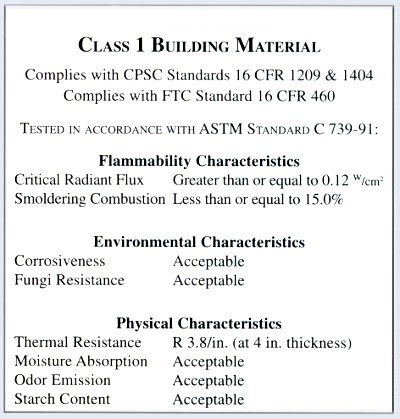
Cellulose insulation is tested and certified in accordance with Federal regulations and ASTM Standard C 739-91 to be non-corrosive. This reassurance gives homeowners a peace of mind that is absent with other insulations that are untested and unregulated.
Cellulose Insulation
Which Energy Saving Improvements Should You Choose?
Here Are The Most Cost-Effective Energy Saving Improvements You Can Make:
- Insulating
- Sealing Major Air Leaks
- Improving Heating System Efficiency
- Installing Hot Water Energy Savers
- Improving Door Windows and Doors
- Purchasing New Energy-Efficient Appliances
- Reduce The Need For Air Conditioning Through Landscaping, Proper Maintenance Of Cooling Equipment And Energy-Wise Habits
FREE Estimate